FDD: Beyond Detection to Verifiable Operational Insight
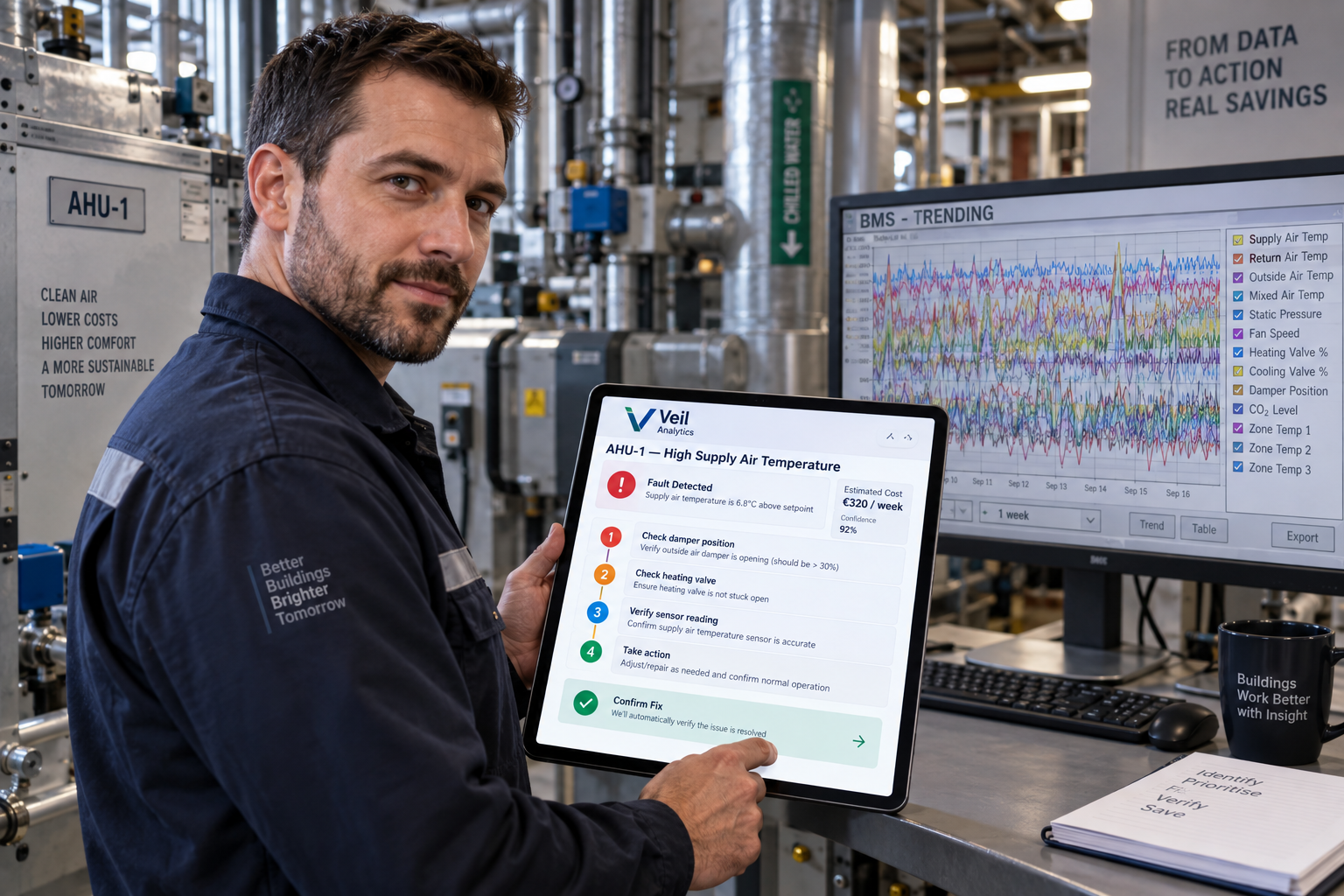
A facility technician uses FDD software to address an HVAC fault, illustrating how 'Veil Analytics' provides verifiable operational insights, step-by-step resolutions, and estimated cost savings to enhance building performance and energy efficiency.
Buildings produce vast amounts of data every day. But is this data truly helping you make better decisions, or just adding to the noise? Many facility managers, energy consultants, and building experts worldwide share this question.
You might feel a constant push for "more data" or "smarter systems." But often, we end up with more alarms, more graphs, and more confusion.
The truth is, your buildings already hold many answers. The challenge is not gathering more data. It is turning the information you already have into clear, useful insights. Insights that people can understand, trust, and act on. Better decisions start when data shows what truly matters.
Imagine your building's system as a complex network of roads. When there is a problem, your current system might just show a "road closed" sign. This is an alarm.
It tells you something is wrong, but not much else. You do not know which road, why it is closed, or how to fix it. This is a common frustration for building operators globally.
They receive many alerts that do not explain the main cause or impact.
Fault Detection & Diagnostics (FDD) is different. It goes beyond just seeing a red light. FDD uses the information already in your building's system.
It finds hidden problems by looking at many data points together. It tells you "what is happening" and "why it matters" in simple terms. This helps teams around the world understand the issues.
FDD looks for patterns and changes that show something needs attention.
Seeing the Whole Picture, Not Just a Red Light
Your existing Building Management System (BMS) or Building Automation System (BAS) collects a lot of numbers. FDD connects these numbers. It sees how a drop in temperature here and a rise in energy use there might mean one bigger problem.
Instead of many small warnings, FDD gives you a complete picture of an operational issue. This method of using existing sensor data to find fault patterns is becoming more common, as recent studies confirm that data-driven FDD methods are gaining ground.
Uncovering Hidden Costs: When 'Detection' Falls Short
Many problems in buildings run silently. They are like a small leak that you cannot see. They cause hidden energy waste and extra maintenance costs every single day.
You might not notice it on your daily report, but your energy bill certainly does. This is a hidden cost that slowly eats into your budget.
Knowing a fault exists is one thing. Understanding its true impact is another. True insight goes beyond simply finding a fault.
It tells you how much that fault is costing you. For example, a damper that is stuck open slightly in an Air Handling Unit (AHU) might seem small.
But it can make your heating or cooling system work harder than needed for weeks or months. This means wasting energy and money.
FDD connects these operational issues directly to actual costs. This helps global teams understand the problem's urgency. It shows facility managers and energy consultants clear numbers.
These numbers make it easier to explain why repairs or upgrades are needed to their finance teams. For example, a system that combines different analysis methods can detect these types of faults in AHUs, helping to pinpoint issues more accurately.
The Real Price of an Unseen Fault
Think about a small temperature sensor that is giving wrong readings. Your heating system might run longer, thinking the room is too cold. Or your cooling system might run less, making people uncomfortable.
These small, continuous faults add up to big expenses over time. They affect your budget and make it harder to reach sustainability goals. FDD helps you see this.
It helps you understand what finding these problems sooner could have saved.
From Data to Action: Achieving Verifiable Operational Insight
You might be thinking, "What do I do after FDD finds a problem?" And "How do I know this works?" This is where true operational insight shines. It offers clear steps. It answers: "What is happening? What does it cost? What should be done?"
FDD uses the data from your BMS/BAS to give you clear advice. It does not just show you raw numbers. It gives a path for facility managers and integrators. This path helps them move from finding a problem to solving it.
Imagine FDD tells you an AHU's fan is running too fast for the cooling load. It shows this is costing you extra energy and money. It then suggests adjusting the fan speed schedule. This is clear advice based on data.
Closing the Loop: Why Verification Ensures Success
When you fix something, how do you know it is truly fixed? Many times, we assume a repair has solved the problem. But without checking the data, it is just a guess.
This is why verification matters. FDD helps you confirm that the problem is truly solved. It lets you see in the data if the system is now working as it should.
This ensures your fix is effective and lasts. For instance, digital twin technology is helping to improve predictive maintenance in buildings, allowing for better verification of fixes.
Global Impact: FDD for Diverse Buildings and Goals
You might wonder if FDD can work for your specific building or in your country. The good news is that FDD principles apply to all building types and climates. From a hospital in Europe to an office building in Asia or a university in North America, the need for efficiency is universal.
It supports energy efficiency and decarbonization efforts everywhere.
FDD helps facility managers, energy consultants, and sustainability leads around the world. It helps them meet different operational goals. The idea of turning data into useful insight is universal.
It adapts to different local rules and business cultures. FDD is a long-term plan for better building performance. It is not just a passing trend.
AI can also help building energy management, including fault detection and energy forecasting, as recent research notes.
Adapting Insight to Local Needs
Each building has its own unique setup. But FDD's core benefits stay the same. It helps you save money, use less energy, and keep people comfortable.
You can tailor how you use FDD to fit your local operational needs and building rules. The logic of connecting data to real-world costs and actions works everywhere.
Taking the First Step: Moving Towards Clearer Operations
You might feel that starting with advanced FDD seems like a big task. But it does not have to be. You can start small.
First, look at the operational data your buildings already collect. It holds many answers. Second, focus on specific questions: "What is costing us the most?" "Which system is not working well?" Third, look for solutions that connect problems directly to clear costs and actions you can take.
Better decisions begin when data clearly shows what truly matters for your building's health and your budget.
References
- DML–LLM Hybrid Architecture for Fault Detection and Diagnosis in ... - pmc.ncbi.nlm.nih.gov
- The Stanford Emerging Technology Review 2026 - setr.stanford.edu
- machine learning-based automated fault detection and - OAKTrust - oaktrust.library.tamu.edu
- Digital Twin Enabled Predictive Maintenance: A Systematic Review ... - preprints.org
- Large Language Models for HVAC Operations in Building Energy ... - arxiv.org